“I can’t spend 10 hours a day at work and 10 hours a day with family. I can’t sleep faster.”
Today on Engineering People:
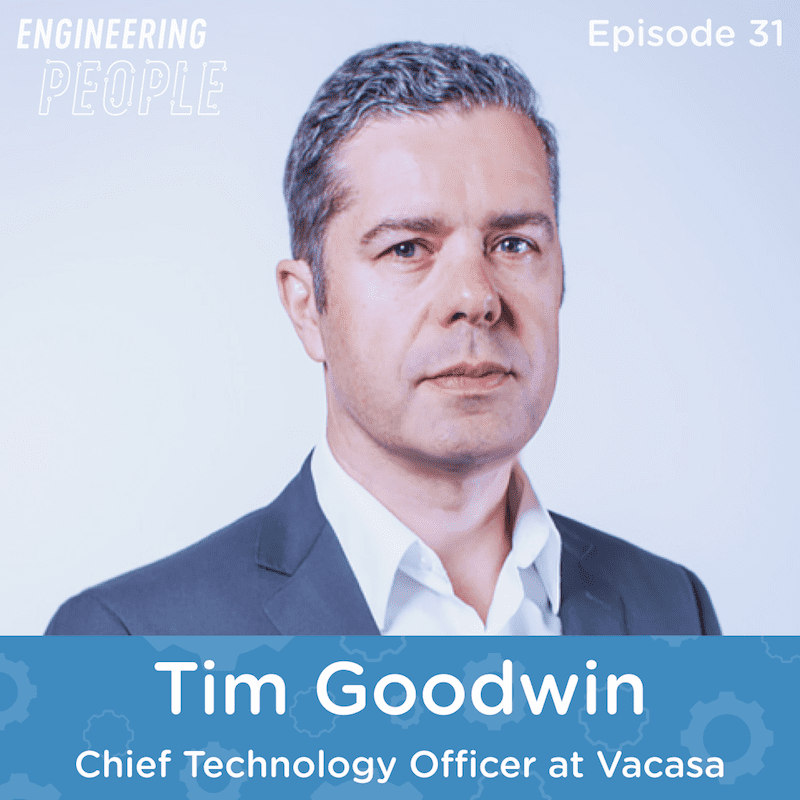
Tim Goodwin joined Vacasa in April 2017 with more than a decade of technology experience. As CTO, his focus is on strategically streamlining Vacasa’s technology processes to prepare the company for continued growth and innovation. Hailing from New Zealand, Tim moved to Portland, Oregon with his family in 2013. He joined Vacasa from Fiserv Inc., where he most recently held the title of Senior Vice President and CIO, managing product development and sustained engineering teams for Digital Channels’ online and mobile solutions.
(Original episode released on September 28, 2018)
Show notes:
Tim on LinkedIn
Vacasa
Careers at Vacasa
Crossing the Chasm: Marketing and Selling High-tech Products to Mainstream Customers by Geoffrey Moore
Inside the Tornado: Marketing Strategies from Silicon Valley’s Cutting Edge by Geoffrey Moore
Transcript, edited for clarity:
Ryan Carson: Welcome to “Engineering People,” the show where we interview the world’s leading engineering managers so we can learn from their experience and ideas. I’m Ryan Carson, the founder of Treehouse, and I’m your host.
At Treehouse, we have experience creating over 850,000 new developers and designers, so if your company is struggling to hire new developers or product designers, just give us a shout. Head to teamtreehouse.com/go/talent.
Today, we’re doing kind of a fun, in-person show. You may hear a little difference in the audio or the length of the conversation. That’s because we’re in-person and we can have a good time.
I’m joined by Tim Goodwin from Vacasa. Thanks for hanging out!
Tim Goodwin: Thanks for inviting me.
Ryan Carson: It’s good to have you in the studio. Fellow Portlander … sort of.
Tim Goodwin: Sort of. I speak funny. I’m New Zealand, but … laughter
Ryan Carson: You were telling me before the show, you have a definitely interesting past as far where the places you’ve lived and been and all that.
Tim Goodwin: Yes. I brought my family out from New Zealand about five years ago. That was a work opportunity. We got acquired by a U.S. company. Prior to that, I lived in New Zealand since about the age of 18. I went to school all different places around the world, including South Africa. I was born in Sweden. Lived all over … my parents were always moving, so my accent’s all over the place.
Ryan Carson: I feel like you have sort of a Kiwi accent. I can pick it up.
Tim Goodwin: Yeah. Well, that’s definitely where I’ve spent most of my time; the place I feel affiliated to.
Work at Vacasa
Ryan Carson: Cool. So, just so the audience knows you a little better, what is your job title and what does Vacasa do?
Tim Goodwin: So, I’m CTO at Vacasa. Vacasa, for the people that don’t know, is a vacation/retail management company. We’re the number one largest vacation rental company in the U.S. now.
Ryan Carson: My wife and I use it. It’s great.
Tim Goodwin: Yeah. We actually manage people’s homes, and do all of the marketing and booking for them. Maintain them and clean them, and facilitate guests to come into them.
Ryan Carson: And how big are you company-wise, employee-wise roughly?
Tim Goodwin: Roughly 2,000 people. Now we’ve got about 10,000 homes in our portfolio. We’re in about a dozen different states, about a dozen different countries as well, now.
Ryan Carson: Got it. Great. I ask everybody this, because everyone’s company or chart is different. So it’s interesting to see how people with different titles fit into different organizations. Yesterday, I was chatting to somebody and they’re an SVP, and interesting enough there was just a CEO and eight SVPs … which isn’t normal, and he knows that. How do you kind of roughly fit in the work chart?
Tim Goodwin: So I’m with the CEO. There’s a number of C-label people … we’ve got a CFO, a COO. Then we have Head of Growth, Head of Review as well. So that’s the management suite.
Ryan Carson: Tell us about the team you manage. Is it engineering? Product? Tell us more about it and how big it is.
Tim Goodwin: So I run all things tech for Vacasa. That includes product development, the product all currently report into me. All of IT. Networks infrastructure.
Ryan Carson: Wow. So all of it?
Tim Goodwin: Basically all of it.
Ryan Carson: Right. Okay. How big is that work?
Tim Goodwin: Right now, it’s about 125 people. A year ago, it was 45, just to give you an idea.
Ryan Carson: Wow. Okay. So it’s scaling fast.
Tim Goodwin: Kind of 2x, 3x kind of growth last year.
Tim’s career history
Ryan Carson: Can you, just for more context, it’d be fun to hear your quick career history. Then I’m going to ask a few questions about your worst job ever, and things like that. Let’s start at a reasonable level back, so people understand how you ended up being the CTO of Vacasa.
Tim Goodwin: Yes. I went to school and got a BS in computer science in Auckland University, and then went out and started working as a coder. Quite early on in my career, I ended up kind of breaking out and actually starting a little web view media company back in the late ’90s.
Ryan Carson: I remember that. I was a developer in a new media company.
Tim Goodwin: Yeah. Well, I had also done a diploma in art through Paris, France. So, the whole thing kind of came together with web and those kind of things. Ran that for about five years. It was a small company. We ended up being about 15 to 20 people, and then got acquired by a management company.
Ryan Carson: Wow. Interesting. And you founded that company?
Tim Goodwin: Yeah.
Ryan Carson: Oh, cool.
Tim Goodwin: And so … then worked with a number of larger tech kind of companies for a few years and missed the whole entrepreneurial scene, so I went back into that kind of startupy space, and landed on product. I’d always kind of been geared around services and tech and it got a little bit boring, saying, “Well, what do you do?” “Well, we’ve got 50 developers. What do you want? We’ll do anything.”
Ryan Carson: Right, right.
Tim Goodwin: So finding product opened my eyes. That was back in 2006, 2007.
Ryan Carson: Got it. You were still in New Zealand at this point?
Tim Goodwin: Yeah. Yeah. So, ended up doing various startups and, you know, telemetry and robotics, a number of different spaces of visualization, and then joined a little phone tech company doing mobile apps for banks. That was Incom. They got acquired by Fiserv. Not Pfizer the drug company, but Fiserv the phone tech. Large kind of four billion, twenty thousand person …
Ryan Carson: Wow.
Tim Goodwin: We ended up working with their Digital Channels Division, and that’s how I ended up in-
Ryan Carson: Got it. So you had been through two acquisitions at that point.
Tim Goodwin: Yes.
Ryan Carson: Interesting. Right. So, when you were studying computer science and art, did you have any inclination that you were gonna be entrepreneurial and start companies, or …
Tim Goodwin: No. No idea.
Ryan Carson: Interesting.
Tim Goodwin: And the tech space was so new at that stage. Back when I was doing it, multimedia wasn’t a thing. I kind of had this notion I wanted to do this innovative, computer arts calling. But we were really experimenting. It was all of these little 3D modeling tools, a lot of graphics, so it was a lot of experimentation. This is where I’d love if I knew then what I know now, I’d come back and look at all of that and so many squandered opportunities.
Influences on managerial style
Ryan Carson: Oh, I know. I know. We have all of them. Tremendous regrets. But that’s okay … we’ll talk. So … I’d love to know something like your favorite book or course or person that’s really affected you or influenced you as an engineering manager or as a leader.
Tim Goodwin: Yeah, there’s probably a few. One of the early ones was some of the Geoffrey Moore stuff. You know, kind of weird titles like Crossing the Chasm and Inside the Tornado. But it helped me understand using frameworks where I was. Particularly, if you’re in that startup space, how do you convince people to take on your product. Once you do get traction, and are fortunate enough to be in a company where everybody wants your product, how do you flip your strategy, and what do you do once you’re in that zone. So that was one.
Ryan Carson: What’s one kind of key take away you can think of from Crossing the Chasm that you could share?
Tim Goodwin: In terms to get traction, just understanding what you needed to do to get by, and how you work with customers very closely. How you need a focus. How you really need a niche. What is the problem you’re solving?
Ryan Carson: Got it.
Tim Goodwin: Being very customer-oriented and listening to their specific needs, versus flipping the scale and what you change to be able to scale fast.
Automated forklifts vs. milk powder
Ryan Carson: Got it. Okay, cool. I would love to know what the funniest, worst or most interesting job you’ve ever had is? I always say this, but just so that the audience can understand … you’ve had this amazing career, you’re a CTO now of a very large company but where did you start from?
Tim Goodwin: So, finding my way through University, I’d take on any jobs I could. Painting houses and things like that. In terms of one of the more interesting jobs, I think startup is hard, and I’ve got a soft spot for startups, and I’m always trying to help them. Ended up in one in New Zealand doing robotics. We’re retrofitting ARM single-board computers and then onto forklift trucks.
Ryan Carson: Oh, gosh. Wow.
Tim Goodwin: So they could drive by themselves and handle material and things like that. I thought I knew a lot of stuff, and got involved … and the next thing I knew, I was in a kind of manufacturing plant walking around there. I knew about software, but I didn’t really know a lot about hardware. So it’s really interesting when suddenly your software is driving a four ton forklift with a two ton pallet. A lot of things can go wrong. Did go wrong. But a lot of things went right. That was probably the more interesting one.
Ryan Carson: Wow. Is that sort of autonomous vehicles a long time ago?
Tim Goodwin: Yeah.
Ryan Carson: Wow.
Tim Goodwin: Industrial automation’s been around for a while, but what we were trying to do … the challenge with the forklifts is if you’ve got an automated vehicle and something goes wrong, which it does, then people don’t know what to do.
Ryan Carson: Right.
Tim Goodwin: But if you have a forklift, you can basically lift the lever, put it into manual mode and just jump in and drive it like a normal forklift.
Ryan Carson: Right, right.
Tim Goodwin: That was kind of quite revolutionary and kind of interesting for people. That was the value prop.
Ryan Carson: Wow. Cool. So, what did go wrong with two tons of flour?
Tim Goodwin: The two tons of milk powder? Well, the challenge was one of the first project implementations we did was taking milk powder off of the manufacturing line and putting it into a day stall, and typically it would be piled too high.
Ryan Carson: Oh, right.
Tim Goodwin: Now, the thing is, when milk powder comes off of the production line, it’s like ball bearings. It’s aerated, and it’s very unstable.
Ryan Carson: Really? Oh, wow.
Tim Goodwin: Your main tool model of how you stack that stuff is you kind of lift it up, put it down on the other one and it’ll stay there, right?
Ryan Carson: Right.
Tim Goodwin: But it doesn’t.
Ryan Carson: No.
Tim Goodwin: So we had to watch the experienced forklift drivers, and they were kind of pushing the tie-ins with tilt, and you’d push the air out of the pallet below or the milk powder below, and then push it down and stabilize it, right?
Ryan Carson: Wow. Interesting.
Tim Goodwin: But each one is just slightly different, so I remember, I think it was like week two on the job. Very little training, and one of the programmers said, “Hey, can you just keep an eye on this? I’ve just gotta shoot to grab something.” The next thing is, the forklift’s backing out and this milk powder all starts tilting and falling out.
Ryan Carson: Oh, my god … and you’re like, “What is happening? Come back!”
Tim Goodwin: Yeah, I know. You had to very quickly hit the stop button.
Ryan Carson: Oh, wow. Okay, that’s exciting.
Tim Goodwin: It was interesting stuff.
Ryan Carson: Yeah. Definitely not something you normally do when you start in computer science and kind of end up in that world, so …
Tim Goodwin: That’s the beauty of tech, right? Particularly the early tech industry. You end up all over the place.
Ryan Carson: Yeah. All sorts of fascinating products.
Tim Goodwin: Different industries and spaces, so …
Ryan Carson: Right, yeah. It is definitely one of the most exciting things, and I think we’re kind of lucky to have studied the right thing at the right time, and it’s now the foundation for the world, basically.
Tim Goodwin: Totally.
Don’t confuse busyness with business.
Ryan Carson: We talked a little bit about this before the show, again, but I would love to hear if you were to go back in time and talk to the younger Tim … sort of grab him and say, “You’ve gotta know these things,” if you could pick two of those things, what would they be?
Tim Goodwin: One of my mentors told me don’t confuse busyness with business. It’s very easy to be busy but it’s not moving your company forward. You’re not actually getting anywhere. So often you’re busy doing stuff — particularly in our industry, you still see it 20, 30 years later where somebody’s like, “Well, I’m not quite sure you’ve been start coding. Put it together.” And you just need that discipline and wherewithal just to step back and think, “Well, hang on. I’m not gonna do anything until I really understand what I’m trying to solve.”
Ryan Carson: Interesting. Which feels slow, doesn’t it? It’s like, “Oh, we’re wasting time.” So you have to avoid that tendency.
Tim Goodwin: A lot of businesses are like that, Ryan. You’d be amazed at how experienced managers do that as well, because they just haven’t taken their time out, stepped back and seen the big picture and really understand the value of what they’re doing. I think in our industry where we think we’re smart people, how much we do this planning and designing in a vacuum, without the data, without full knowledge of what’s really happening.
Ryan Carson: Right. How do you bounce from that, though, with the same idea of, “Well, we need to also just try something very simple and get it out sooner so that we can get feedback?”
Tim Goodwin: That is a thing, right? If you know what you’re trying to solve for or you have a hypothesis then you need to work out what’s going to prove that and whether that’s really a stable foundational way to move. And the less you do and the quicker you get that feedback. So I think it ties in really well with that whole Lean startup kind of approach.
Ryan Carson: Got it. Okay, cool. So that was lesson one, basically, take time to plan and think and strategize before you just jump in and start doing work, because busyness is not business. Okay. That’s a good one.
Tim Goodwin: Yeah. And that progressive commitment of, “Okay, I’m going to invest a few hours to work out whether I need to invest a few days and a few days to work out whether I want to invest a few weeks and so on. And that was one of the other lessons back in the day from one of the places I work.
Having your own story
Ryan Carson: So what would be another big lesson that you had taught yourself?
Tim Goodwin: Well, a big one for me and it was more kind of once I got into larger companies was just making sure that I had a story and that I wasn’t part of somebody else’s story.
Ryan Carson: Oh, interesting.
Tim Goodwin: Another way to say it is be strategic, but a lot of people don’t fully understand that, especially in tech. We’ve got a lot of precesses and we can be involved with a lot of stuff and doing a lot of things, but if you don’t really understand the platform, what are you trying to sell? Where do you really deliver value for that business? So if you picture yourself bumping into one of the board members and you’re in an elevator for 20 seconds and they ask you, “What are you doing?” You can’t say, “Well, I’ve been going to meetings and I’ve been doing my scrum ceremonies and I wrote some code.” That’s not the story. Right?
Ryan Carson: No.
Tim Goodwin: But if you have the story about that problem you’re solving or, “I’m doing this thing that’s going to deliver 20% revenue or solve this major issue for out customers,” then-
Ryan Carson: That’s compelling.
Tim Goodwin: Yeah. And if you don’t have that, then where are you really heading?
Ryan Carson: Right. That’s interesting. It seemed like there’s two reasons you might do that. One would be personal advancement as your career, but also clarity and advancement at work. Is that correct? Career goals at work mean you’re doing clear work.
Tim Goodwin: Yes. I don’t know of any executive team, particularly as you get more senior, or any business team that is 100% happy with what their tech team’s delivering. A lot of the time they don’t even know what it’s delivering.
Ryan Carson: Right. Interesting.
Tim Goodwin: So you need to be very clear on what it is. And just correct you’ve worked with a particular head of department and they’ve said, “I want X,” it doesn’t mean they really need X. Right?
Ryan Carson: No. Right. Right. That’s interesting.
Tim Goodwin: So how do you kind of really step back, work with enough people to understand what is that story? What are you really doing? Is it important? You’re going to make a difference or you’re just kicking the can down the road.
Ryan Carson: Yes. Gosh. You’re right, there’s not enough understanding on that from non-technical executives on what you’re doing and the value that you’re delivering.
Tim Goodwin: Or even technical executives. And the more you kind of abdicate that responsibility to a product team or your CEO or your CPO, then people aren’t always right. You need to think it through. I mean, it’s not about challenging everything and not learning the fundamentals, but taking that time out.
Ryan Carson: Gosh, that’s great advice and no one has said that yet in all the interviews we’ve done. I’ve heard some really tough stories where you have a CEO saying to a CTO, “I’m convinced that X% of your team are not delivering value so go cut them.” Because they don’t understand at all what’s happening. Right?
Tim Goodwin: Yeah.
Ryan Carson: So that’s smart. I guess it’s going to … I have-
Tim Goodwin: It’s hard to get right. You need to refine. You need to revisit that. It’s not like you sit down and five minutes later you understand what that is. Right?
Ryan Carson: Yeah.
Tim Goodwin: You need to really understand your business and the challenges.
Ryan Carson: Well, which is part of the value of doing that. Right? Because then you have to go through the mental exercise of saying, “Oh, wait. Yeah, what are we doing that’s mapping to the company two-year vision or one-year vision and how will I explain that?” And then you say, “We’re not doing anything that relates to that. Okay, we need to do that.”
Finding, hiring and retaining diverse talent
Ryan Carson: What are y’all doing at Vacasa that is working in regards to hiring and retaining diverse talent?
Tim Goodwin: Look, it’s really topical and it’s easy to get PC about it, so kind of my focus is what are tangible things we can do to make a difference? One thing is making it a priority, communicating it to your recruiting team so they understand the importance of what you’re trying to achieve versus just put butts in seats. Second one is, we do sponsor a number of different events and things like PDX Women in Tech.
Ryan Carson: They’re great.
Tim Goodwin: We got a good space in our offices. We support those kind of events. Another thing is, beyond just training and making people aware is also on any interview panel, making sure you’ve got enough diverse people. Making sure there’s a woman on the panel or whatever kind of group you’re trying to make sure that you’ve got inclusion on. And then those people feel there’s enough people like them there that they then want to come into the place. They’re not going to be the token person.
Ryan Carson: Right. Right. Got it. Okay, great. Thanks for sharing that. How do you currently find new product design or development talent. How does it work at Vacasa?
Tim Goodwin: How do we define new products or the talent or-
Ryan Carson: No, how do you find the talent?
Tim Goodwin: Yeah, it’s hard. It’s tough. I mean, we run our recruitment pipelines like everyone else and just bringing people through the door. So we’ve got people that source, recruiters in-house.
Ryan Carson: Got it. Cool.
Tim Goodwin: Yeah. Just put their heads up.
Ryan Carson: Right. And just crank.
Tim Goodwin: Yeah. And then try to talk to lots of people.
Ryan Carson: Right. Yep. How do you measure retention on your team? I mean, is that something you do measure at a higher level?
Tim Goodwin: I’ve been pretty lucky. Retention’s pretty high in Vacasa.
Ryan Carson: Well, why?
Tim Goodwin: Part of it might be that were pretty young. We’re growing fast, I think. I think it’s a interesting space. It’s a cool industry to be in. We’ve got a lot of tailwinds around the whole sharing economy. The HomeAways and Booking.coms, the Airbnbs of the world, drive a lot of demand so that the companies growing fast. It’s a fun place to be when you can hire your way out of a lot of trouble. It’s not the kind of industry where you’re trying to find efficiencies. It’s massively fragmented. There’s so much, some people hate the term, but low-hanging fruit in terms of we’re doing lots of innovative stuff, lots of interesting stuff. So I think that fuels it. We’re lucky to be in the heart of the Pearl. You know, dogs and kombucha and the whole quintessential Portland.
Managing teams across Portland, Boise … and Chile
Ryan Carson: Yeah. I saw your sign the other day and I feel like you moved in that recently-ish or no, have you been there forever?
Tim Goodwin: It’s been a few years. I think it’s two or three years, now, and we’re about to move into a new one. So right next door.
Ryan Carson: Got it. Bigger and better.
Tim Goodwin: We’ll probably retain both space because we’re growing so fast. But I think the company’s going into this Goldilocks zone. It’s not that kind of startup where you’re struggling to find your next meal ticket and it’s not so big that you’re becoming a faceless person.
Ryan Carson: What’s your take on building a remote engineering team and product team versus in-person?
Tim Goodwin: We try and take advantage of that. We recently set up a team in Chile because we do have a lot of international folk in different locations that we’re supporting. And there’s nothing like an international team to actually be able to support and understand and have that empathy around what those people need. So that’s one piece of it. The key thing for me is one, is the time zone so that people aren’t starting … They don’t get home, have dinner and then start their second shift. I’ve worked in places where that’s been the case. Right?
Ryan Carson: Right. Which is why you chose Chile?
Tim Goodwin: Yeah. So having some kind of overlap. They’re about three hours away in time difference. And just really finding really good, talented, strong people that they’re as good.
Ryan Carson: But as far as the US goes, everyone’s in Portland.
Tim Goodwin: No, we actually recently picked up more tech people in Boise.
Ryan Carson: Oh, really?
Tim Goodwin: There was a team over there that had been told if they didn’t move to another city then they were out of a job. So we went and chatted to them. There was about 10 of them, really strong, really capable team. We were like, “Okay, if can get three or four then we’ll set up an office here.” And we got all 10. So that was awesome.
Ryan Carson: Oh, cool. So that’s nice.
Tim Goodwin: We started to become a bit more distributed and that’ll help us scale faster because scaling more than one location is easily than scaling just the one.
Ryan Carson: Yep. Got it. What is your technical stack roughly like and how do you … I’d love to hear a little bit more of the detail around running the team around that.
Tim Goodwin: So what, traditionally, and the legacy stuff’s all PHP, MySQL, right? And that was good to get the company to where it needed to be for that time. You said we’re doing a lot more kind of Python, Node.js and a different frame with Django framework, CMS Wagtail on the back there. But a lot of opensource on Amazon, all in the cloud, starting to use Lambdas and everything. So for me, it’s about what works and really pulling everything into event and service space architectures that can scale and, again, do the job we need as we grow.
Ryan Carson: Cool. I’m always fascinated to hear about how people think about career leveling and paths and advancement and engineering. So walk us through what you think is best practice as far as creating that leveling structure and seeing people’s careers grown inside the company to increase retention overall.
Tim Goodwin: Yeah. So Fiserv was very formative. I’d worked in a lot of smaller companies. New Zealand’s well-known for being generalists. And what was interesting was a lot of the kind of frameworks and knowledge we picked up there. So one is setting up the job ladders and the different levels that people can go through, and recognizing that, also, there should be a career ladder of individual contributors.
Ryan Carson: Not just into management.
You don’t just decide at a time, a particular point, and go, “Okay, you’re a manager now. Congrats. You were our best coder but now you can be our most mediocre manager.”
Ryan Carson: That doesn’t work? No.
Tim Goodwin: Well, I don’t know. It’s been tried many times. Let’s put it that way. So making sure that people can keep progressing their individual contributor careers, that they understand kind of options around different job ladders. One thing’s added recently was we tended to have those kind of junior mid-senior level. And one of the issues for me is your mids get to a point where they grow super fast and so I flipped it to kind of a three-level. So you’re software engineer one, two, three, and then senior, because we didn’t want to dilute the senior. And I needed some in between mid to provide recognition for productivity for having the technical skills, but maybe you’re still developing some of that main knowledge, business knowledge, leadership skills.
Ryan Carson: So one, two, three, four, senior?
Tim Goodwin: One, two, three and then senior.
Ryan Carson: Senior. Got it. Oh, interesting.
Tim Goodwin: As opposed to junior, mid, senior.
Ryan Carson: Yeah, right. Those are only three.
Tim Goodwin: Because you get basically your mids, after three minutes, figure they need to be senior or something.
Ryan Carson: Yeah, right. That’s cool. Do you make it very clear to the organization, these are the levels, these are the pay grades. Or is it-
Tim Goodwin: Yes.
Ryan Carson: Okay, got it.
Tim Goodwin: Yeah. I’ll use industry data. What’s the market rate? What is the low, mid, high? What’s their ratings, performance? Where should they be relative to parity?
Ryan Carson: Yep. Okay, cool.
Tim Goodwin: Do we pay women same as men? Those kind of things. And also the attribute. A lot of people aren’t sure of what the gaps are, and quite often their managers can’t fully tell them what do they need to do to make the next level. So we map out, based on the seniority or the level-
Ryan Carson: Got it.
Tim Goodwin: -what are their attributes. Not just technical, but communication, leadership, domain.
Ryan Carson: Okay, cool. Do you have the concept of mentoring inside the company formally at all, or anything like it?
Tim Goodwin: Not really, no. I mean, I’ve worked in companies where we have and I don’t know that it’s worked well necessarily.
Ryan Carson: What was the problem?
Tim Goodwin: Part of the issue is people just fully understanding kind of what’s involved and what’s expected.
Ryan Carson: Okay, what is this.
Tim Goodwin: What’s good about it is that somebody can have a informal chat — it’s not their manager, they don’t feel like they’re under pressure to portray things a particular way. Their manager might be stopping them from maybe progressing in their career because they’re just too damn useful where they are.
Ryan Carson: Right, right, right. Yeah.
Tim Goodwin: So having that external support, and mentorship, and dialogue is good, but it’s very much dependent on the quality of that person and what they know.
Ryan Carson: Right, right. Got it. Okay, great. How do you all do … How do you communicate out to the whole company what engineering is doing? Not just, we talked about executives and the Board, what about the rest of the company?
Tim Goodwin: Part of it is geared around different OKRs … they’ve got some tools around some of the objectives and things like that.
Ryan Carson: Right. There you go.
Tim Goodwin: … so that’s good in terms of an alignment in objectives kind of thing. We also have been experimenting a bit with some of the Juro tools, with CamBam boards.
Ryan Carson: Oh cool.
Tim Goodwin: And one of the things we’re looking for there is making sure the different delivery teams have focus. They’re not trying to do 20 different things.
Ryan Carson: Yeah, right.
Tim Goodwin: Right. And content switching all the time.
Ryan Carson: Yeah.
Tim Goodwin: So we look at how many items they have work in progress.
Ryan Carson: Right and it needs to not be more than X.
Tim Goodwin: Exactly. And two or three at absolute most, right.
Ryan Carson: Yeah.
Tim Goodwin: And then do we have things that are shovel ready? So as soon as they’ve finished their job, is it specd out? Is there a requirement spec, design spec? What are the different tools to make sure that when they are ready for that next thing it’s there.
Ryan Carson: It’s ready to go. Got it. Wow, okay. This is your chance to plug your job board or your career page. How many people are you hiring and where should people go?
Tim Goodwin: We’re hiring a lot. We’re growing fast. We’ll probably aim to double over the next kind of 12 to 18 months.
Ryan Carson: The engineering or the whole company? Or everything?
Tim Goodwin: So the tech predominantly but I mean the company’s growing fast.
Ryan Carson: Got it. Yeah.
Tim Goodwin: So hiring across the board but tech in particular, I think there’s a huge opportunity. Cloud for automation and different opportunities in the company, and particularly in this industry.
Ryan Carson: Cool.
Tim Goodwin: So yeah. So we’re looking for engineers, product managers, QA, you name it.
Ryan Carson: Tons, right. And I presume people just google “Vacasa jobs.”
Tim Goodwin: Yeah, just go to our careers page and click on view, the orange button at the top saying view openings, job openings.
Finding your work/life balance with four fingers
Ryan Carson: Right. Cool. Nice. You know, we talk a lot about our professional lives but the truth is we’re all full humans with loved ones and hobbies and things. How do you think about your personal goals and your personal life compared to your goals at Vacasa? Like how do you sort of run your life when it comes to advancing at work but also advancing your personal goals?
Tim Goodwin: So back when I was running my own company, I kind of formulated this little framework, right. And I basically say to people, “Don’t live your life like this. Live it like this.”
Ryan Carson: Okay. So people listening, he’s holding four fingers sideways versus up.
Tim Goodwin: Right. So when you hold it up, your first finger is your education.
Ryan Carson: Okay.
Tim Goodwin: Then you’ll go get a job.
Ryan Carson: Get a job. Education, job.
Tim Goodwin: Yeah, and then you might want to get married and have kids.
Ryan Carson: Right.
Tim Goodwin: Right. Now if something goes wrong with one of those you’ve stopped, you’ve stalled.
Ryan Carson: How interesting, right.
Tim Goodwin: But if you invest, if you hold your hand sideways, you invest in each of those things. If one’s down, the other’s are up, it carries you through.
Ryan Carson: How interesting, right.
Tim Goodwin: So don’t not spend time on your hobbies, or your health, or your partner, your wife, your kid. So you’ve got to work out how do you calibrate that.
Ryan Carson: Interesting.
Tim Goodwin: And it swings around. There’s different times it’s going to demand different intensity.
Ryan Carson: Right.
Tim Goodwin: But hey, something happens at work, you’re feeling a bit down but there’s all these other things that are happening. I just hit these goals in my particular hobby or sport. So as long as you have those goals, they’ll be times when those things carry you through.
Ryan Carson: Right.
Tim Goodwin: You’re doing it linear if you’re doing it one at a time.
Ryan Carson: Right.
Tim Goodwin: Your whole world stops, right, if something goes wrong. You didn’t get that promotion or something bad happened.
Ryan Carson: Right. So it’s almost diversification of your columns in life. I can’t just have an amazing job. I also need a strong support with my loved ones and I also need to be healthy. So I have to like-
Tim Goodwin: Yeah. So the problem that comes in is the compromise, right, in terms of what is your goal. You can’t necessarily be the best father, the best boss, so at times you need a strategy or a plan to get you to what’s the most important thing.
Ryan Carson: Right.
Tim Goodwin: I can’t spend 10 hours a day at work and 10 hours a day with family. I can’t sleep faster.
Ryan Carson: Right. Yeah, I wish. Right. Yeah. In the past year, even six months, I’ve noticed my health declining a little bit because I’ve been focusing so heavily at work. And it’s just a little bit but I have noticed, yeah it’s really hard to maintain the intensity exactly the same all the time. And one is deteriorating a little bit so like-
Tim Goodwin: And that’s where I come back to what’s the story, because when you do get more strategic and you are more focused on what’s important, then you have more time.
Ryan Carson: Right.
Tim Goodwin: If you’re just running around tactically trying to do everything, you don’t have the time.
Ryan Carson: Right.
Tim Goodwin: And things fall apart.
Ryan Carson: Yep. Yep. So how do you stay focused on the big, important goals then, in these areas? What’s your methodology?
Tim Goodwin: It’s hard. I mean you’ve just got to make time to sit down and plan it out. Be strategic. Play it through in your mind’s eye and look at where do you want to be. Have those goals for three, five years or whatever it is.
Ryan Carson: Are you like a paper and pen person in a Moleskin somewhere? Put them on the wall? Are they just in your head? How do you keep track of that stuff?
Tim Goodwin: I mean, from a business point of view I like to put plans together. Write kind of whatever you want, whether it’s drawings, or Excel sheets, you use what works for you.
Ryan Carson: Right.
Tim Goodwin: So it’s up to the individual, really.
Ryan Carson: Cool. Nice. So last question. What’s your main kind of hobby thing or passion outside family and work?
Tim Goodwin: I like a lot of outdoor recreational sports. You know it’s part of the reason we came to Oregon. So I like to mountain bike, and snowboard, and rock climb. I like to spend quite a bit of time over in Bend.
Ryan Carson: Nice. Yeah. Oregon is really great for that. When we were deciding to move here it was like “Gosh. Wow, the beach is like right there. Mount Hood’s right there. It’s a walkable city. This is kind of crazy.”
Tim Goodwin: Yeah. There’s a lot to do. I mean a lot of people freak out about how quickly it’s growing and cost of living but that’s still affordable compared to Seattle-
Ryan Carson: And still not San Francisco so, very happy about that.
Tim Goodwin: Yeah. Where did you move out from?
Ryan Carson: So we moved from Bath, England.
Tim Goodwin: Oh, okay. Great.
Ryan Carson: It was a long story but I grew up in Colorado. Went to Colorado State. Got a degree and then I was like, “I’ve never lived anywhere else. I wonder if my world view’s limited. I wonder if I’m never going to leave.” So I watched a movie and thought it was about London. I thought, “London looks kind of fun.” And so I moved there and then realized you had to have a lot of money to live like that in London.
Tim Goodwin: In London, London yeah. For sure.
Ryan Carson: So then was just going to stay for a year but then I ended up meeting a girl and stayed for 12 years.
Tim Goodwin: As you do.
Ryan Carson: Yeah.
Tim Goodwin: Yeah. But you didn’t pick up much of an accent.
Ryan Carson: No. I like get zero accents.
Tim Goodwin: Yeah, Bath.
Ryan Carson: No, I had zero accents. My kids … we had two kids over there and they … it’s crazy. They had British accents.
Tim Goodwin: Yep.
Ryan Carson: And then we moved here and now they’re just American kids. It’s so weird.
Tim Goodwin: How old were they?
Ryan Carson: They moved when they were … let’s see. There’s 10 and 7 now so they were 2 and 5.
Tim Goodwin: Right, right.
Ryan Carson: Yeah. So now we’re like, “You’re half British.” And they’re like, “Okay.”
Tim Goodwin: Yeah. That’s pretty young.
Ryan Carson: Do you have kids or anything?
Tim Goodwin: Yeah. I have a 13 and a 16 year old.
Ryan Carson: Okay. Got it. Wow. Well that’s it for the show. It’s been really interesting to hear,. like especially things about like you were saying, learn how to explain the value of what you’re offering at a high level so that you can advance your career but also stay focused on it. That was really fascinating. And I thought the whole four fingers sideways versus up is a cool way to look at it, so I appreciate you sharing those things.
If listeners want to find you and want to chat to you, where’s the best spot for them to go?
Tim Goodwin: Just hit me up on LinkedIn or email me at tim.goodwin@vacasa.com.
Ryan Carson: Perfect. And once again, if you’re listening and you’re wanting to work at Vacasa, which sounds like an amazing company and the product’s really good because we use it, just head to Vacasa and look for the job site.
Tim Goodwin: Yeah. Please apply. There’s a lot going on. There’s lots of stuff happening.
Ryan Carson: Lots of good things. Well thanks Tim.
Tim Goodwin: Thank you.
Ryan Carson: Good to chat.
Tim Goodwin: Yeah. I appreciate it. Thanks for your time.

The post The Engineering People Show, Episode 31: Tim Goodwin appeared first on Treehouse Blog.
from Treehouse Blog https://ift.tt/2DOLXL5
via https://ifttt.com/ IFTTT